
Small Entryway Shoe Storage: 3 Layouts for Foyers and Mudrooms
Give everyday shoes a place near the door. Choose a layout around your wall space, hanging coats, and the way people move through the room.
As an Amazon Associate we earn from qualifying purchases.
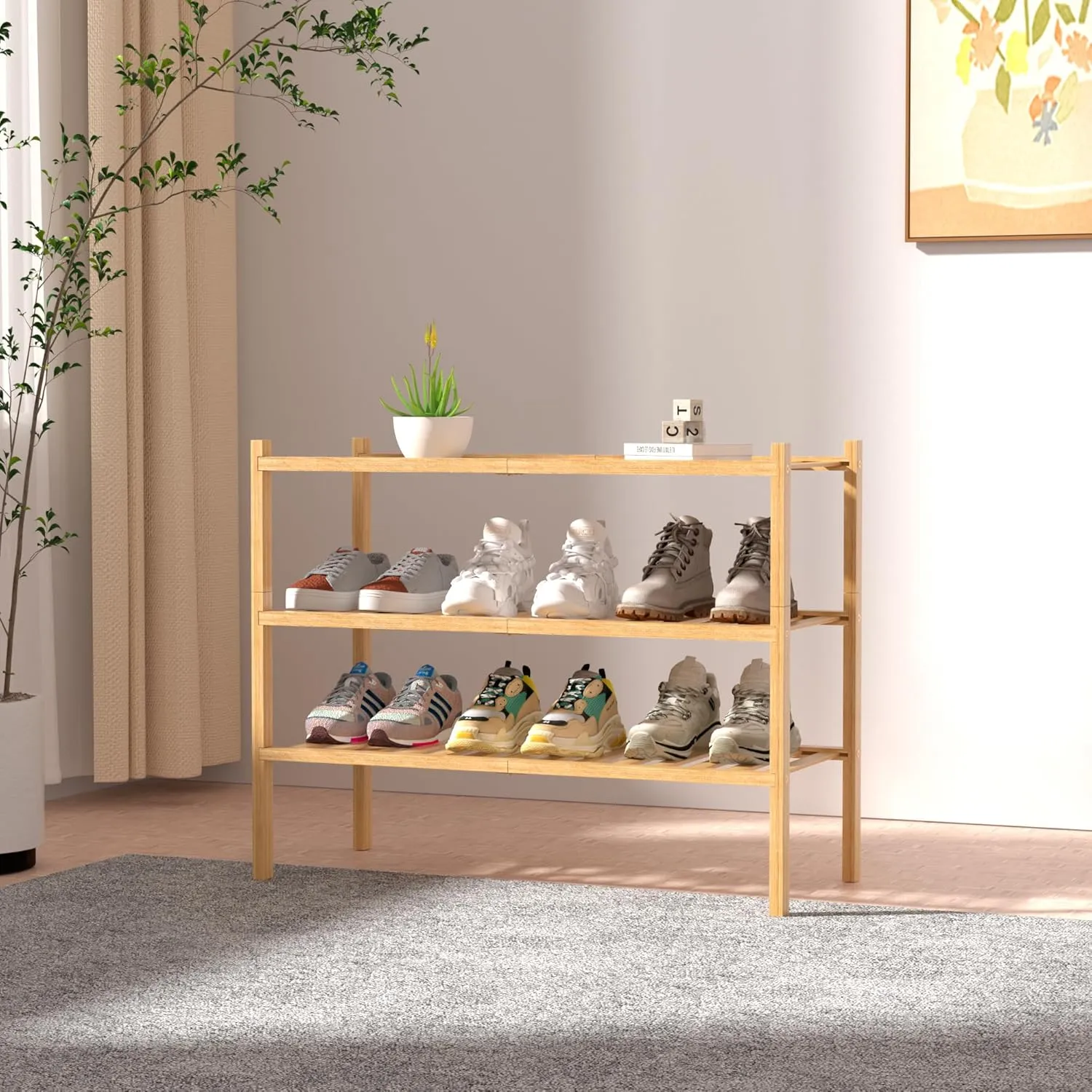
Small entryway shoe storage works best when it follows the routine at your front door. Where do you stop to take off your shoes? Where does your bag go? Can someone else get past while you are getting ready?
Start with the pairs you reach for during an ordinary week. Keep occasional and out-of-season footwear elsewhere if the entrance cannot comfortably hold it. That gives you a smaller, more useful storage job to solve.
For an open rack, three layouts are worth testing: along a clear wall, beneath existing coat hooks, or inside a nearby closet. The right choice depends on the whole setup, including shoes, door movement, and access—not just the furniture’s listed footprint.
Check your available space with the shoe rack fit tool →
Choose a rack, cabinet, or bench around your routine
An open rack is useful when you want to see and reach your everyday pairs. A cabinet makes sense when concealing shoes matters more. A purpose-built shoe bench adds somewhere to sit, provided you have room to use it.
Compare the particular products you are considering. A cabinet is not automatically deeper than a rack, and an open rack still needs space in front of it for the person retrieving shoes.
| Storage format | Why choose it? | Space to check |
|---|---|---|
| Open shoe rack | Everyday pairs remain visible and easy to select | Rack footprint, shoe overhang, and room to bend or reach |
| Closed shoe cabinet | Shoes are hidden when the doors or drawers are shut | Closed dimensions, usable compartments, and the full opening movement |
| Shoe storage bench | A place to sit while putting shoes on | Furniture footprint plus space for legs and getting up; confirm it is designed for seating |
| Boot tray or basket | A separate place for a small footwear group | Outside dimensions and whether shoes stay contained without spilling into the route |
If sitting down is part of your routine, plan an actual seat. A tiered shoe rack should not be treated as a bench unless the manufacturer specifically permits that use.
Three layouts for small entryways and mudrooms
A rack along a clear foyer wall
Use a wall segment beside the entrance, beyond the door’s normal opening movement. This keeps shoes close to where you take them off while giving each pair an obvious place to return to.
For a 27-inch-wide wall position, compare the Standard bamboo shoe rack at 11 inches deep with the Thick bamboo shoe rack at 12 inches deep. Their three-tier versions are listed at 20 and 21 inches high, respectively.
Mark the footprint from the baseboard or trim that will stop the rack, then place your longest everyday shoes at the front edge. Test opening the door, carrying your usual bag past, and reaching the lowest shelf. If any part crowds the route, try another position.
Choose the deeper rack only when its dimensions suit the location and footwear. The word “Thick” does not establish a higher load limit or guarantee that a particular shoe size will fit.
A low rack beneath existing coat hooks
Where hooks already form a useful landing spot, place shoe storage below them so coats and shoes share one part of the room. Let the actual coats determine the clearance: hang the longest ones you use, including anything carried on the hooks, before measuring down to the floor.
A three-tier Long bamboo shoe rack is listed at 35 inches wide, 11 inches deep, and 20 inches high. It offers more width along a wall than the Standard rack while keeping the same listed depth and height. It also needs that longer wall segment to remain clear.
Check the space above the shoes on the top shelf, rather than measuring only to the rack frame. Leave access to switches and outlets, and check that a hanging bag will not cover the shelves.
Keep keys and mail in an existing tray or suitable wall storage if you have it. If you add floating shelves, choose their position around reach, coats, and the supplied mounting instructions. A fixed hook or shelf height will not suit every household.
A rack inside the closet nearest the entrance
If the open hallway is too tight, move the shoe station into a nearby coat closet. This can keep the entrance visually clear without adding furniture to the passage itself.
The three-tier Small bamboo shoe rack is listed at 18.1 inches wide, 10.7 inches deep, and 17.5 inches high. It is a starting point for a short closet wall; a wider rack may work better where there is more usable wall space.
Measure through the closet opening as well as inside it. Check sliding panels, hinged doors, tracks, and hanging clothes. A rack that fits in a recessed corner may still be awkward to reach. Test taking shoes out with the door in its normal open position.
For a closer look at the Small rack’s two heights, read the narrow shoe rack guide.
Compare the floor space before choosing a layout
These three-tier examples show the outside dimensions to mark on the floor. The area calculation is width × depth ÷ 144; it describes the rack’s rectangle, not the total space needed to use it.
| Three-tier rack | Width × depth | Height | Approximate floor area |
|---|---|---|---|
| Small | 18.1 × 10.7 in | 17.5 in | 1.34 sq ft |
| Standard | 27 × 11 in | 20 in | 2.06 sq ft |
| Thick | 27 × 12 in | 21 in | 2.25 sq ft |
| Long | 35 × 11 in | 20 in | 2.67 sq ft |
Dimensions come from the Amazon listings recorded in our catalog on October 17, 2026. The three-tier Standard, Thick, and Long figures were also cross-checked against their Amazon product pages for this guide. They are listing measurements, rather than independent measurements of assembled racks. Check the selected size and finish before ordering.
The Standard and Thick ranges need the same wall width; the Thick uses one extra inch of depth. The Long adds eight inches of width to the Standard footprint. The Small saves wall width, with less outside width available across each shelf.
Usable shelf width, shelf depth, and the clear height between tiers are separate measurements. Confirm them with the seller if your decision depends on a specific pair count, large shoe, or boot. Do not estimate capacity from a lifestyle photo.
For the complete height and finish matrix, see the shoe rack dimensions and sizes guide.
Compare the exact three-tier options and check prices on Amazon →
Make the shoe station work on wet-weather days
A mudroom layout has to account for what arrives with the shoes. Decide where muddy or dripping footwear will go before filling the rack with clean everyday pairs.
A separate boot tray can give those shoes their own place, if it fits without obstructing the entrance. Measure the tray’s outer edge and keep the route clear. Do not assume there is room to slide one beneath a rack; that clearance is not confirmed in this catalog.
Open shelves leave footwear visible, but that alone does not establish drying time, odor prevention, or resistance to water damage. Follow the rack’s supplied care and use instructions, and confirm suitability before planning to store wet footwear on it.
For the everyday routine, give each person a shelf or section where practical. Return pairs that are no longer in use to other storage. If shoes regularly spill beyond the station, reduce the rotation or reconsider the location before adding another unit.
Test the layout with the space in use
Before ordering, mark the proposed rack with painter’s tape or cardboard and run through a normal arrival and departure:
- Open every nearby door fully. Include handles, cabinet doors, and closet panels. Check shoes projecting beyond the frame as well as the rack itself.
- Try retrieving a pair. Allow for bending, reaching, or using a separate seat. An open rack has no cabinet-door swing, but the person using it still occupies space.
- Pass through with the things you carry. Try your bag, groceries, or mobility equipment, and check access to adjacent rooms and furniture.
- Check the height in context. Include shoes on the top shelf, hanging clothes, windows, switches, and anything you need to reach above it.
There is no single rack depth that makes every entryway workable. If the test crowds a doorway or passage, use another wall, nearby closet, or different storage format. The fit tool compares available dimensions with listed rack sizes; door movement, shoe overhang, and room to use the rack need separate checks.
Questions to settle before buying
Can I put a shoe rack behind the front door?
Only if the door and handle can move through their full normal range with the rack and shoes in place. Do not assume the space behind a door is usable because it looks empty when closed. Measure and test the actual opening movement.
Should I choose a taller rack or a wider one?
Choose around the available wall and usable height. A wider, lower rack may work beneath hooks; a taller rack may suit a clear closet section. Check access to every shelf and follow the instructions for the exact model. Do not assume two units can be stacked.
Will a 12-inch-deep rack fit large men’s shoes?
Outside depth and shoe size labels cannot confirm that fit. Measure your actual footwear and ask for the usable shelf dimensions. A shoe can project beyond a rack even when the rack itself fits the floor space.
Choose the location, then the rack
Keep the daily rotation small enough for the entrance, choose one of the three layouts, and test it with shoes and people in place. Then use the shoe rack comparison to choose the width and height that match that location.
The options below are all three-tier racks in Natural, so you can compare their listed sizes directly. Other tier counts and finishes are available through each product page.
Compare the three-tier racks in this guide
Check the current price, delivery, and availability for the exact size and finish on Amazon.
As an Amazon Associate we earn from qualifying purchases.
 Check price on Amazon
Standard bamboo shoe rack, 3 tier, Natural
27 in W × 11 in D × 20 in H
 Check price on Amazon
Thick bamboo shoe rack, 3 tier, Natural
27 in W × 12 in D × 21 in H
 Check price on Amazon
Long bamboo shoe rack, 3 tier, Natural
35 in W × 11 in D × 20 in H
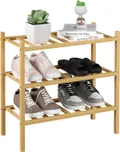 Check price on Amazon
Small bamboo shoe rack, 3 tier, Natural
18.1 in W × 10.7 in D × 17.5 in H