
Narrow Shoe Rack Guide: Choosing Storage for a Small Space
Measure the space, check your footwear, then choose a rack that works for your closet or entryway.
As an Amazon Associate we earn from qualifying purchases.
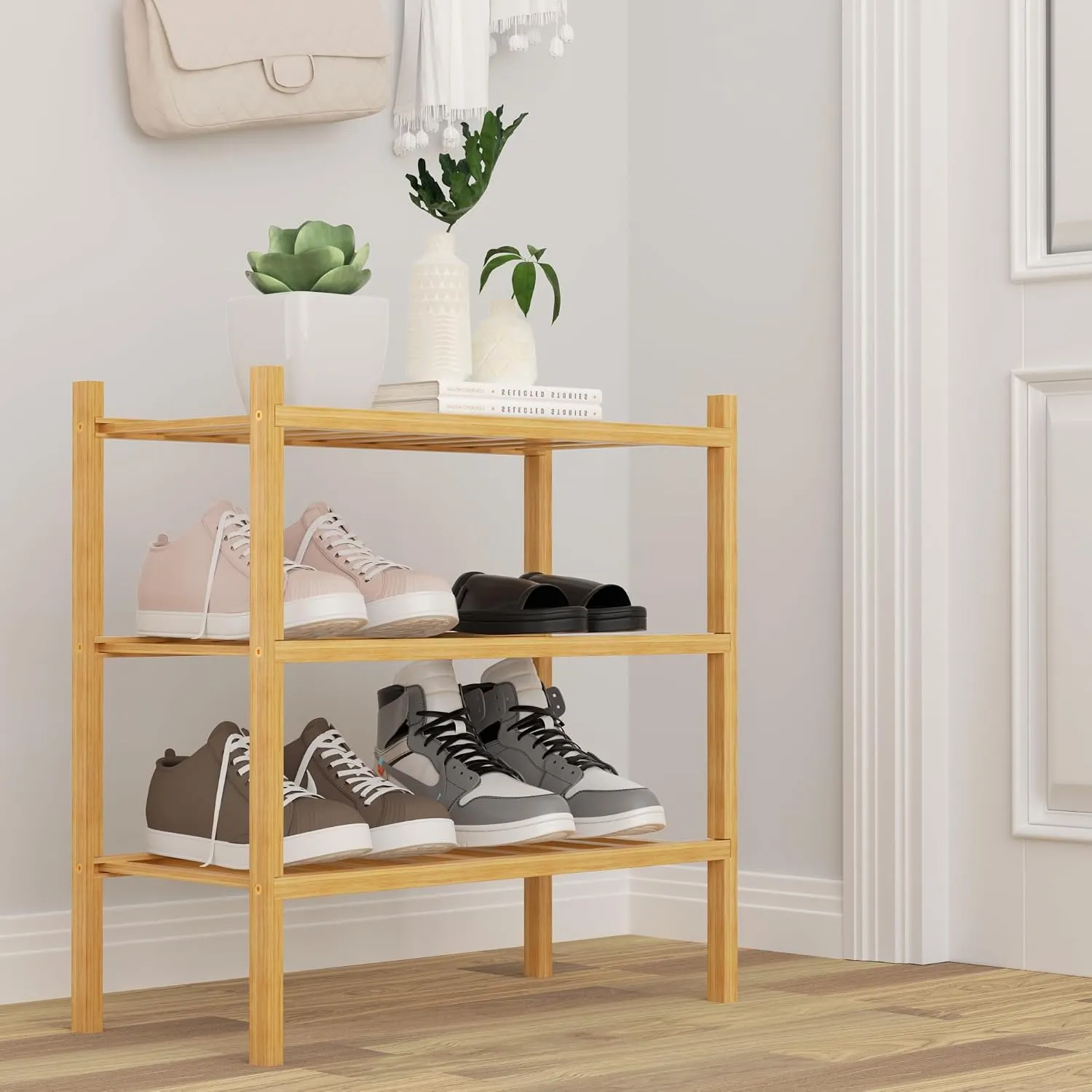
An empty gap beside a closet or front door can look like the perfect home for a shoe rack. Then the door catches a shelf, a sneaker sticks into the walkway, or the top row disappears beneath hanging coats.
The useful question is more specific than “Will a narrow shoe rack fit?” You need to know whether the rack and the shoes on it fit—and whether you can reach them once it is in place.
For a space under 20 inches wide, the ROMGUAR CRAFT Small Bamboo Shoe Rack is one option to measure against: it is listed at 18.1 inches wide and 10.7 inches deep, with a 17.5-inch three-tier version and a 35-inch six-tier version. Both use the same floor footprint.
Start with your available width, depth, and height. Then check the footwear you actually want to store.
Check your space with the shoe rack fit tool →
Narrow width and shallow depth solve different problems
A rack can be narrow along the wall and still project too far into the room. Before comparing products, identify which dimension is limiting you.
| What limits your space? | What to measure |
|---|---|
| A short wall or a gap between furniture | The clear width available for the rack |
| A narrow passage beside the rack | The depth of the rack with shoes in place |
| Clothes, a window sill, or a shelf overhead | The rack’s height plus the shoes on its top shelf |
| A nearby hinged or sliding door | The space needed for the door and handle to move freely |
“Small,” “slim,” and “narrow” are useful search terms, but the measurements determine the fit. Check all three dimensions rather than choosing by the product name.
Choose between three and six tiers
The Small Bamboo Shoe Rack comes in the following listed configurations:
| Configuration | Width × depth | Overall height | Finish |
|---|---|---|---|
| Three-tier Small rack | 18.1 × 10.7 in | 17.5 in | Natural |
| Six-tier Small rack | 18.1 × 10.7 in | 35 in | Natural |
| Six-tier Small rack | 18.1 × 10.7 in | 35 in | Black |
These are Amazon listing dimensions recorded on October 17, 2026, rather than independent measurements. The catalog currently includes Black only in the six-tier Small rack.
Choose three tiers when height is the constraint. The lower rack is worth considering beneath short hanging clothes or a low window sill. Measure the actual clearance, including room for shoes on the top shelf and your hand when taking them out.
Choose six tiers when width is the constraint and you have usable height. It provides twice as many shelves on the same footprint. Check that the taller rack will not block a closet rail, outlet, switch, or anything else you need to reach.
Compare the three listed options and check prices on Amazon →
Check the footprint before you order
Use painter’s tape or a piece of cardboard to mark an 18.1 × 10.7 inch rectangle where the rack would stand. Position it against the part of the wall or trim that will actually stop the rack from moving farther back.
Then run through these four checks.
1. Measure at the narrowest point
Measure between baseboards, door trim, furniture, and other obstructions. A gap measured higher up the wall may be narrower at floor level.
In an unobstructed 20-inch-wide gap, an 18.1-inch rack leaves 1.9 inches of total spare width. That is a useful starting calculation, but check the full space the rack will occupy. Do not plan around a fit that depends on squeezing the frame between obstructions.
2. Open the nearby doors
With the footprint marked, open the entryway door and any nearby closet, cabinet, or room door through their normal range. Check the handles as well as the door panels.
A spot behind a door is useful only if the rack and shoes allow the door to operate fully. Do not assume a hinge-side corner has enough clearance because it looks empty when the door is closed.
3. Add your shoes to the depth check
Place your longest everyday pair where the shelf would sit, in the direction you intend to store it. If the toes or heels project beyond the marked rectangle, include that extra space in your room measurement.
Walk past the marked area and check access to adjacent furniture. If the setup crowds a passage, choose another location or a different storage format. A smaller footprint does not make an obstructed doorway or route a good storage spot.
4. Check the space above the rack
Measure from the floor to the lowest obstruction: the hem of a coat, a window sill, or the underside of a shelf. Allow for whatever will sit on the top tier and for taking it on and off.
Rack height and usable shoe clearance are different measurements. A rack that fits beneath clothing may still leave its top shelf difficult to use.
How many pairs will a narrow shoe rack hold?
The reliable way to estimate capacity is to start with your footwear. Shoe size alone does not tell you a shoe’s outside dimensions: a slim dress shoe and a bulky running shoe can take up different amounts of space despite carrying the same size label.
Gather the pairs you want to store and arrange them as you would on a shelf. Measure the group’s width, the longest sole, and the height of any boots or high-tops.
Compare those measurements with the rack’s usable shelf dimensions and clear space between tiers, rather than assuming the full 18.1-inch outside width is available between the frame supports. Those internal clearances are not confirmed in the current catalog, so check them with the seller if your purchase depends on a particular pair count or boot fit.
The same applies to slatted shelves: consider whether your footwear needs a more continuous supporting surface. Product photographs can show the layout, but they cannot establish a guaranteed capacity for your collection.
Where a small shoe rack can work
Beneath hanging clothes in a small closet
Measure with the clothes hanging normally, including the longest items that will remain above the rack. Check whether you can reach every shelf through the closet opening. A rack in a recessed side corner may fit on paper but be awkward to use.
The three-tier version is the shorter option; the six-tier version needs a taller clear section of the closet.
Beside the entrance
Choose a wall segment that keeps shoes near the door while leaving the door swing and the route through the room clear. Test the footprint with the shoes in place before deciding that a narrow rack solves the problem.
For an everyday drop zone, start with the pairs you use most often. Storing an entire collection at the entrance may call for more room than that location can comfortably provide.
For room-layout ideas, compare three ways to organize shoes in a small entryway or mudroom.
In a taller closet corner
A six-tier rack can make use of height where a wider rack would not fit. Check both access and overhead obstructions, and follow the product’s supplied assembly and use instructions.
Plan around a single listed configuration. Confirm the manufacturer’s instructions for your exact model before considering any stacked arrangement.
When a wider rack is the better choice
If you have the wall space, compare a wider rack before committing to the narrowest option—especially if you store bulky shoes or want more room across each shelf.
The shoe rack dimensions guide lists all 11 size configurations and explains how to measure beneath hanging clothes.
| ROMGUAR CRAFT range | Listed width × depth | What to compare |
|---|---|---|
| Small bamboo shoe rack | 18.1 × 10.7 in | The narrowest footprint in this lineup |
| Standard bamboo shoe rack | 27 × 11 in | More width with a similar listed depth |
| Thick bamboo shoe rack | 27 × 12 in | The same width as Standard, with an extra inch of listed depth |
| Long bamboo shoe rack | 35 × 11 in | More width along a longer wall |
The Small rack uses 8.9 fewer inches of wall width than the Standard rack. Its listed footprint is about 1.34 square feet, compared with 2.06 square feet for Standard. Choose according to the space and shoes you need to accommodate; the smallest rack is useful only if it meets both needs.
Compare sizes and check what fits your space →
The fit tool compares your available width, depth, and height with the listed rack dimensions. Account for shoe overhang, door movement, and access separately.
Questions to settle before buying
Will the Small rack fit in a 20-inch gap?
Its listed width is 18.1 inches, leaving 1.9 inches of total spare width in a clear 20-inch gap. Also check the 10.7-inch depth, the chosen height, trim, door movement, and the space occupied by shoes.
Will large men’s shoes or boots fit?
Measure the actual soles and boot height, then confirm the usable shelf width, depth, and clearance between tiers. An overall rack dimension or shoe size label cannot establish that fit.
Can I get the three-tier Small rack in Black?
The current catalog lists the three-tier Small rack in Natural. The six-tier Small rack is listed in Natural and Black. Check the selected size and finish on Amazon before ordering.
Does a six-tier rack take up more floor space than a three-tier rack?
Both Small versions have the same listed 18.1 × 10.7 inch footprint. Their heights differ: 17.5 inches for three tiers and 35 inches for six tiers.
Choose the footprint first, then the height
Mark out the space, test the door movement, and measure the shoes you plan to keep there. If the 18.1 × 10.7 inch footprint suits the location, compare the two heights on the Small Bamboo Shoe Rack product page. If you have more width available, use the shoe rack comparison and fit tool to check the other ranges.
Compare the listed Small rack options
Check the current price, delivery, and availability for the exact size and finish on Amazon.
As an Amazon Associate we earn from qualifying purchases.
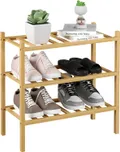 Check price on Amazon
3 tier, Natural
18.1 in W × 10.7 in D × 17.5 in H
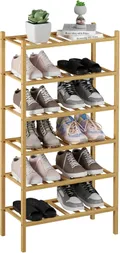 Check price on Amazon
6 tier, Natural
18.1 in W × 10.7 in D × 35 in H
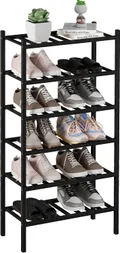 Check price on Amazon
6 tier, Black
18.1 in W × 10.7 in D × 35 in H