
Vertical Plant Display for Small Spaces
Plan around your plants, not just the stand. Measure pots, foliage and access before choosing a six-tier display.
As an Amazon Associate we earn from qualifying purchases.
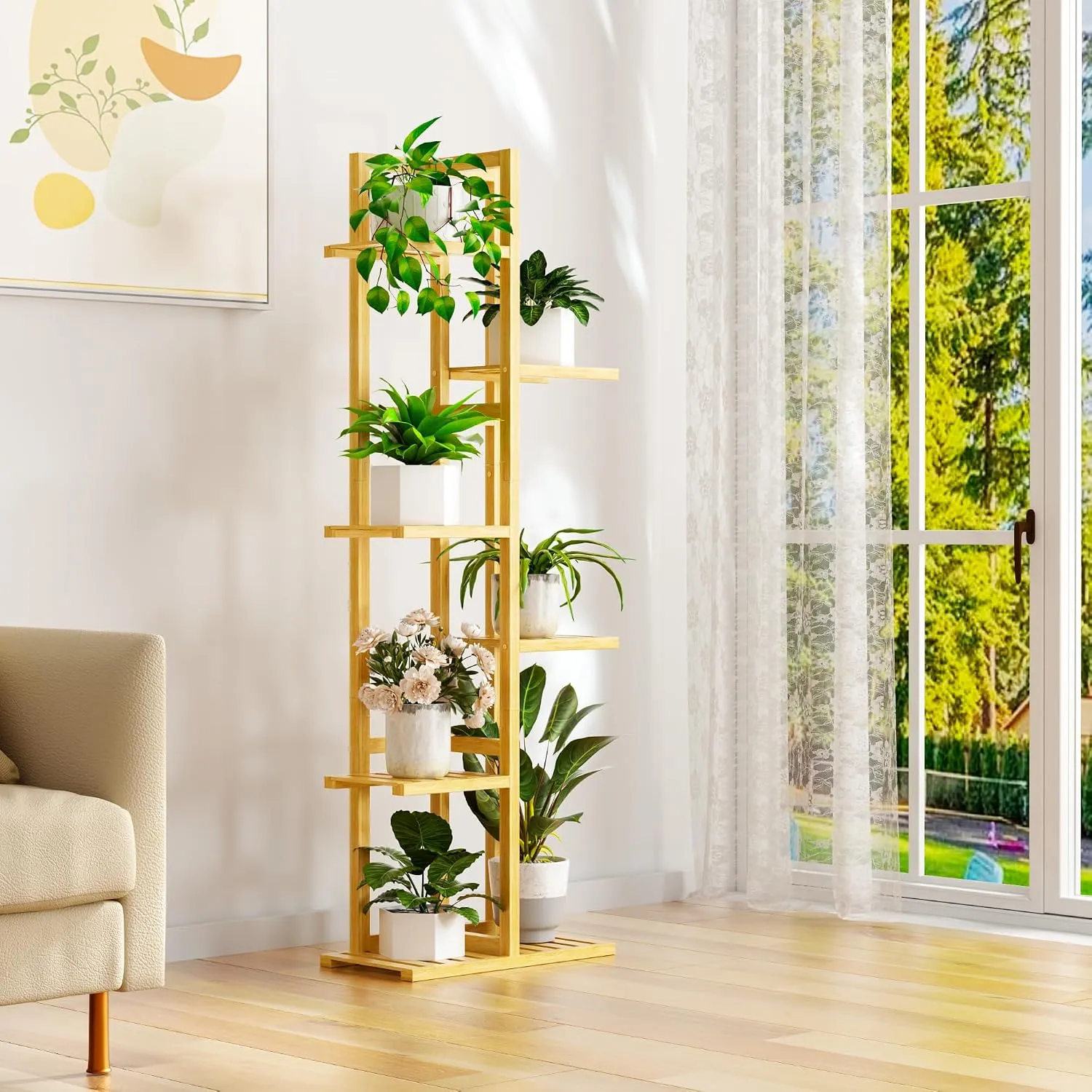
A plant stand can move a collection off a crowded windowsill, but the stand’s dimensions are only the starting point. Leaves extend beyond pots, saucers take up shelf space, and every plant needs to be reachable when it is time to check the soil or empty a tray.
The ROMGUAR CRAFT six-tier bamboo plant stand is listed at 15.75 inches wide, 8.15 inches deep and 48 inches high, with shelves that alternate from side to side. That describes the bare stand. Your pots and foliage determine how much room the full display needs.
Start with three checks: the room, the plants and access for care. A place that accommodates the frame may still be too narrow for spreading leaves or too awkward for removing a pot.
Start with the listed size and shelf arrangement
The catalog lists one six-tier configuration in Natural, White, Brown and Black. The outside dimensions are the same across those four listed variants.
| Catalog detail | Listed figure | What to check separately |
|---|---|---|
| Outside width | 15.75 in | Pots, saucers and leaves extending to either side |
| Outside depth | 8.15 in | Any gap behind the stand and growth extending forward |
| Overall height | 48 in | The highest leaves, nearby fittings and your reach |
| Tier count | 6 | Usable space and access at each proposed pot position |
| Shelf shown in the dimension diagram | About 7.5 × 7.5 in | Usable surface, frame obstructions and clearance above each shelf |
These are listing figures from our catalog, captured October 17, 2026, rather than measurements we have taken. The original dimension image identifies the width, depth and height directions and includes a separate shelf-size inset.
The alternating shelves create display positions on both sides of the upright frame. They do not establish a standard height allowance for every plant. Dividing 48 inches by six does not give the clear space above a shelf. Overall height includes the frame, and the shelf above an object may overlap only part of its position.
The 7.5 × 7.5-inch diagram label is also not a confirmed usable measurement for every platform. Ask for the width, depth and overhead clearance at the positions you intend to use if a particular pot must fit.
Plan the space around the whole display
Use paper or removable tape to mark the listed 15.75 × 8.15-inch footprint at your proposed location. Check the actual wall, baseboard and floor; a trim projection may prevent the stand from sitting where the outline first suggests.
Next, measure how far your plants would extend beyond that outline. Include the widest pot rims and saucers as well as leaves and trailing stems. Use the furthest projection on each side of the planned arrangement, rather than adding the spread of every plant together.
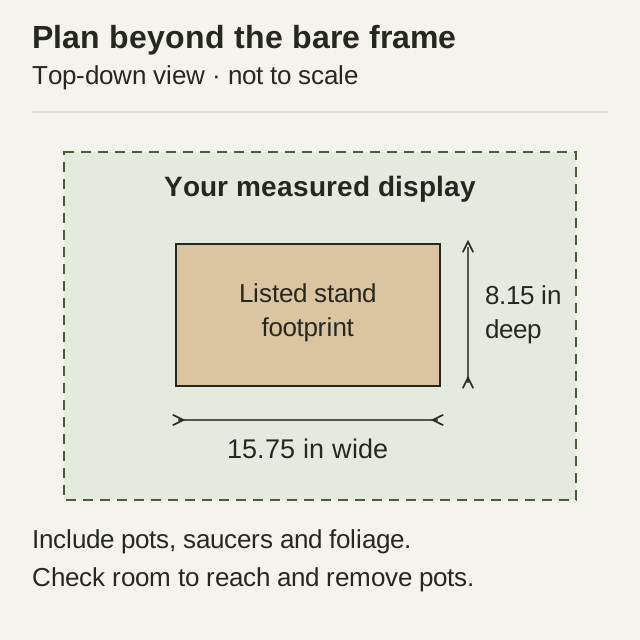
For a hypothetical width calculation, suppose the leftmost leaves extend 3 inches past one side of the frame and the rightmost leaves extend 4 inches past the other. The display would span 15.75 + 3 + 4 = 22.75 inches. Those overhangs are example measurements, not recommended spacing or a predicted fit for this stand.
Check depth the same way: any measured gap behind the stand, plus its listed depth, plus the furthest forward projection. Keep room for reaching the plants as a separate check. There is no fixed watering aisle or baseboard allowance that suits every room.
For total display height, measure from the floor to the highest point you expect the plant to reach. Do not assume the top shelf surface is exactly 48 inches above the floor or simply add a pot height to the overall frame height.
Measure pots, saucers and plants together
Gather the pots you want to display before choosing positions. A nursery pot’s size label does not tell you the width of its saucer, the flare of a decorative outer pot or the spread of the plant above it.
Record these measurements for each plant:
- The support footprint: Measure the pot base, saucer or outer container that will actually rest on the shelf. Note the full outside width as well as the part that touches the surface.
- The widest container point: A rim or handle may meet an upright even when the narrower base appears to fit.
- The full plant height: Measure from the bottom of the complete pot-and-saucer arrangement to the highest leaf or stem.
- The spread and trailing growth: Check both directions across the plant and note stems that would hang below the shelf.
Compare those notes with usable shelf dimensions and the surrounding frame. The product photos show slatted surfaces, so also check how the pot or saucer would be supported. A shape fitting within an outside measurement does not establish suitable support or load capacity.
Avoid turning six tiers into a promised pot count. The number that works for your collection depends on the containers, plants, usable shelf space and product guidance. Leave a position unused if it would crowd the arrangement or obstruct access.
View the plant stand gallery and finish selector →
Check reach, doors and everyday use
Try the care movements you will need at the proposed location: standing beside the display, reaching a lower pot, lifting an upper pot and carrying it away. Account for furniture that will remain in place. A chair or table can leave the frame visible while making part of it difficult to reach.
Three checks help with common small-space locations:
- Beside a window: Open and close the curtains or blinds. Check their actual travel, plus any window handle or opening sash, against the planned pots and foliage.
- Beside an armchair or sofa: Check the space people use to sit, stand and pass the furniture. Include spreading leaves and trailing stems in that check.
- Near a doorway or room corner: Open nearby doors fully and check the handles as well as the door edges. A corner position does not automatically keep a planted display clear of movement.
Think about future growth, too. Leave space based on the plants you have and expect to maintain, then revisit the arrangement as they change. This is a reason to plan fewer positions at first rather than filling every opening from a photograph.
Match light to the actual shelf position
Choose the location with your plants’ light needs in mind. University of Illinois Extension’s houseplant lighting guide explains that both light intensity and duration matter, and that requirements vary among plants.
Look at conditions where each pot would sit: the window’s direction, curtains, nearby obstructions and shading from other plants. Do not assume that the highest shelf always receives the most useful light, or that every position on a stand beside a window receives the same light.
Use care guidance for your particular plants to decide whether the location works. This guide does not assign species to tiers or prescribe one grow-light schedule for the whole display.
Make watering and assembly part of the plan
Choose containers and saucers that let you manage drainage without treating the stand as a catch tray. Plan how you will remove a pot, let it drain where appropriate and empty its saucer without disturbing the plants beside it.
University of Illinois Extension’s watering guidance recommends checking each plant’s needs and emptying excess water from saucers after watering. A regular calendar alone does not account for differences in plants, pots and growing conditions.
Include the saucer in your fit measurements, and follow the stand’s applicable care instructions. Neither the bamboo material nor a staged plant photo establishes waterproof performance.
Before buying, check the instructions supplied with the exact model for assembly, permitted loads and any placement or wall-fixing requirements. Per-shelf loads, total loads and stability guidance are not confirmed in this catalog. A lower shelf is not evidence of a higher load allowance. Ask the seller for those details when pot weight or placement determines your decision; do not borrow ratings from a similar-looking stand.
Choose a finish after checking the measurements
Write down the available room width and depth, the full display height you can accommodate, and the dimensions of the complete pot-and-saucer arrangements. Add notes about door travel, light and how you will reach each plant.
If you still need a particular shelf clearance or load limit, settle that question before choosing the stand. If wall-mounted display space would suit the room better, the corner vs. straight shelf guide explains that separate planning option.
The four finishes below share the same listed stand dimensions. Choose Natural, White, Brown or Black on the product page, then check the current Amazon listing for that exact finish. The finish name changes the catalog option; it does not establish a different pot capacity or performance rating.
Compare the four plant stand finishes
Check the current price, delivery, and availability for the exact size and finish on Amazon.
As an Amazon Associate we earn from qualifying purchases.
 Check price on Amazon
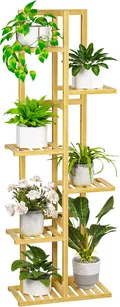
Bamboo plant stand, Natural
15.75 in W × 8.15 in D × 48 in H
 Check price on Amazon
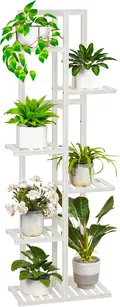
Bamboo plant stand, White
15.75 in W × 8.15 in D × 48 in H
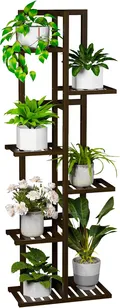 Check price on Amazon
Bamboo plant stand, Brown
15.75 in W × 8.15 in D × 48 in H
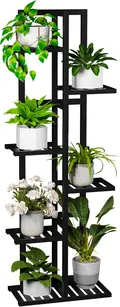 Check price on Amazon
Bamboo plant stand, Black
15.75 in W × 8.15 in D × 48 in H