
Corner Shelves vs. Straight Floating Shelves
Compare the shapes and listed sizes, then check wall space, access, and the things you want to display.
As an Amazon Associate we earn from qualifying purchases.
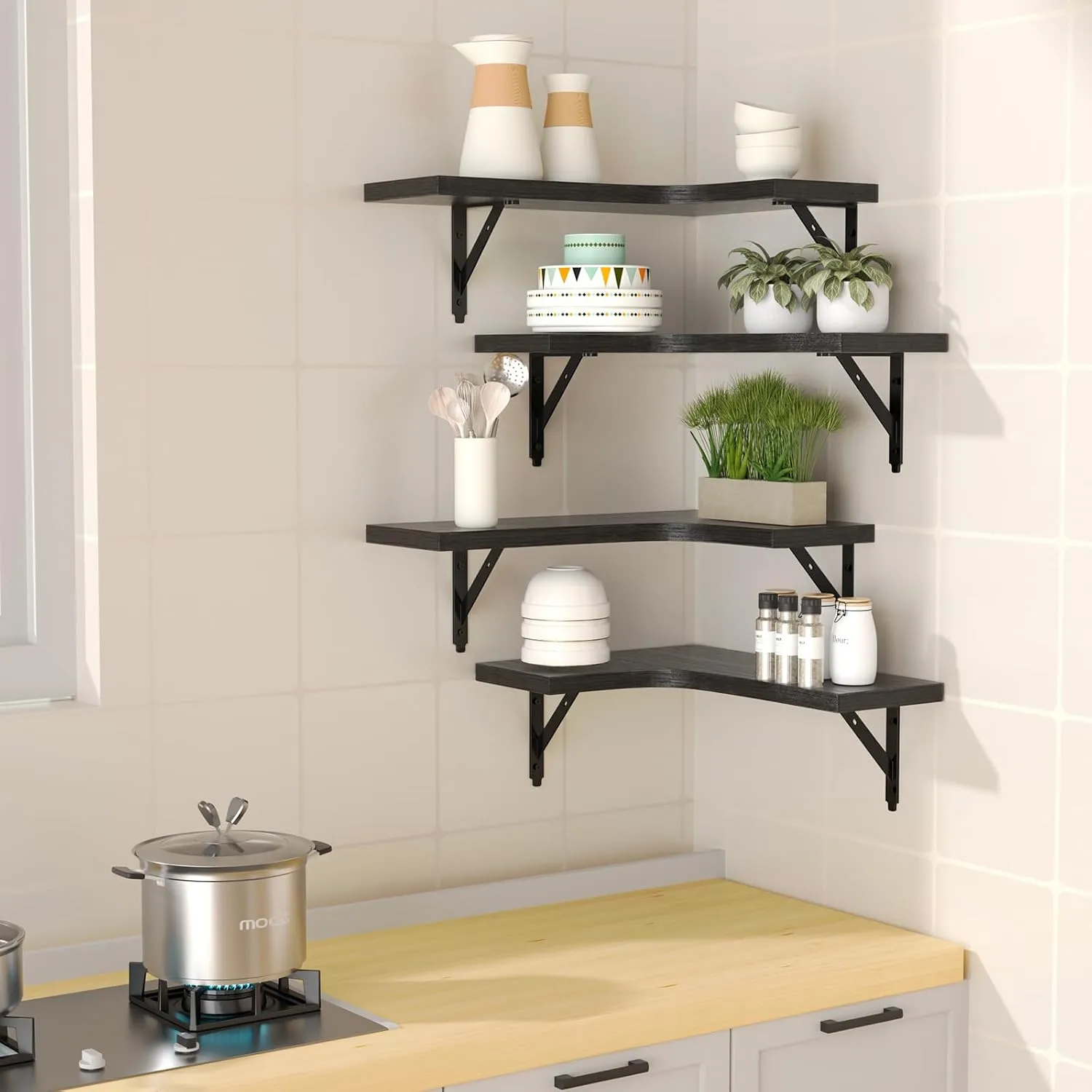
A corner beside a desk and a clear wall above it offer two different places for a shelf. Start with the location you want to use, then compare the shelf’s shape with the space and objects you have.
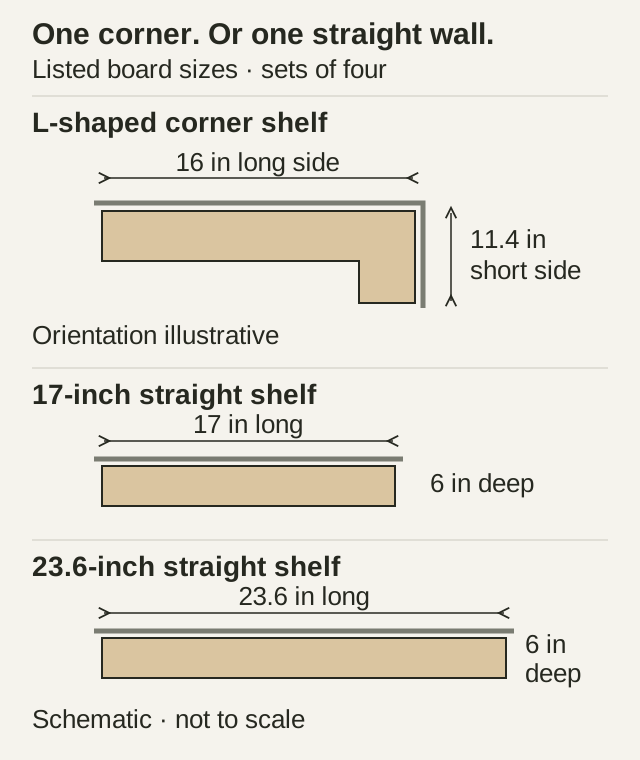
Consider corner shelves when you want a display that turns along two adjoining walls. Consider straight shelves when you want a row of items along one wall. ROMGUAR CRAFT’s corner shelves have a listed 16-inch long side and 11.4-inch short side. The straight shelves come in 17- and 23.6-inch lengths, both listed at 6 inches deep. Each set contains four shelves.
Both lines are sold as “floating shelves,” and both have visible black metal brackets. In this guide, corner and straight describe the board’s shape and placement. The comparison covers wall-mounted shelves; a freestanding corner bookcase is a different storage format.
Compare both sets in the floating shelves collection →
Compare the listed shelf sizes
The corner set has one listed size in seven finishes. The straight set offers two lengths, each in the same seven finish names. All three options are wood shelves on metal brackets.
| Shelf option | Shape and listed dimensions | Board thickness | Shelves per set |
|---|---|---|---|
| Corner set | L-shaped; long side 16 in, short side 11.4 in | 0.6 in | 4 |
| 17-inch straight set | Rectangular; 17 in long × 6 in deep | 0.6 in | 4 |
| 23.6-inch straight set | Rectangular; 23.6 in long × 6 in deep | 0.6 in | 4 |
These are Amazon listing figures from our catalog, captured October 17, 2026, rather than measurements we have taken. Check the exact length and finish on Amazon before buying, especially for a close fit. Board thickness does not tell you the installed height of the brackets.
What do the corner measurements mean?
The corner board is L-shaped. 16 × 11.4 inches does not describe a solid rectangular display surface. The listings reverse the width and depth labels across finishes, so this guide uses “long side” and “short side” instead.
A listing diagram labels one arm end as 5.5 inches across. That label does not confirm both arms’ usable depth or how much room remains around the inner curve. If a particular pot, frame, or other object determines your choice, ask the seller for usable dimensions at the place it would sit.
Measure a corner or a straight stretch of wall
Take measurements at the height where you intend to place each shelf. A wall that looks open from the floor can have trim, a cabinet, or a fixture in the way higher up.
For a corner: check both walls
Measure from the corner along each wall to the nearest obstruction, such as a mirror frame, window casing, cabinet, or door trim. Compare those spans with the listed long and short sides.
For a tight space, confirm which wall the long side follows in the intended mounting arrangement before ordering. Do not assume that you can flip the board or reverse the brackets to exchange the sides.
Also check the corner’s shape and surface. Uneven walls, trim, or a corner that is out of square can affect how a board meets the walls. The catalog does not establish a permitted corner-angle range or gap allowance; ask the seller about your location if these details matter to the fit.
Explore the corner shelf set and its finishes →
For a straight shelf: check one continuous span
Measure the clear length along the wall and the space projecting out from it. Compare the length with 17 or 23.6 inches, and account for the listed 6-inch depth, the brackets, and anything you plan to display.
For example, a hypothetical 20-inch clear wall section is longer than a listed 17-inch board and shorter than a 23.6-inch board. The smaller board leaves 3 inches of length in total. That subtraction is a first check: bracket clearance, positioning, access, and nearby obstructions still need to work.
Compare the two straight shelf lengths →
Check doors, reach, and room access
Open nearby room doors and cabinet doors through their full normal travel. Check the space at the proposed shelf height, including handles and anything that could project beyond the board. A corner location still needs this check.
Think about reaching the shelves after the room is furnished. A desk, armchair, or counter beneath them may change where you can stand and how easily you can lift something on or off. Check the highest planned shelf as well as the lowest.
Three room examples show how those checks change the choice:
- Beside a bathroom mirror: Compare the clear spans on both walls if you are considering a corner set. Check medicine-cabinet doors, access to fixtures, and any toilet tank lid that must be lifted. Room labels in a listing do not establish suitability for direct splashes or steam.
- Above a home-office desk: A straight shelf gives you an uninterrupted line along the wall. A corner set changes the display’s direction. Check whether the desk or monitor would obstruct access to either part of the corner.
- Near a kitchen cabinet: Test the cabinet’s full door travel and the motion of removing items from it. Measure at every proposed shelf level; a clear counter below does not establish clear space above.
Choose the position that leaves the room usable, rather than deciding from the empty wall alone.
Measure the things you want to display
Gather the objects before choosing a shelf. Measure their full support footprint, height, and any overhang, then allow space to pick them up and put them back.
- Plant pots: Include the saucer or outer pot, and check where leaves and stems extend. A pot’s advertised size is not necessarily its base measurement. For a freestanding option, the vertical plant display guide explains how to measure the full planted arrangement.
- Photo frames: Include the stand when it is open. A 4 × 6-inch photo size does not describe the frame’s depth on a shelf.
- Books: Measure the books in their intended position and the width of the whole group. Shelf length alone does not establish how many books can be stored.
- Bottles and jars: Check the bases, lids or pumps, and the motion needed to lift each item clear of the shelf above.
For straight shelves, the listed 6-inch depth is a starting point. For the corner board, confirm usable space along each arm and near the turn. An object fitting within a board’s outline does not establish that its weight or placement is suitable. Follow the applicable product and mounting instructions.
Plan a layout for four shelves
You can compare a column of shelves, staggered positions, or two separate pairs. Choose the layout around the objects, the space to reach them, and the bracket arrangement supported by the instructions.
For a corner display, sketch the objects along both walls so the turn becomes part of the arrangement. For a straight-wall display, sketch the shelf lengths above the desk, counter, or other furniture you want them to sit over.
If you are considering two straight boards side by side, two 17-inch boards total 34 inches in board length; two 23.6-inch boards total 47.2 inches. Add any planned gap to that sum. These are separate shelves: the calculation does not establish a seamless joint or a supported continuous surface.
Decide vertical spacing from the tallest objects, the room needed to remove them, and bracket clearance. There is no single shelf gap that suits every display. Matching finish names across the two product lines also do not guarantee an identical color; compare the photos for the exact variants.
Check installation and care before buying
Both sets attach to the wall on metal brackets. Review the assembly guides to understand the work involved, and follow the instructions supplied with your exact product for installation, fixings, use, and care.
The site’s assembly guidance advises keeping the wood dry. Do not use bathroom or kitchen listing photos as evidence of waterproof performance. If moisture exposure or a specific load determines your purchase, obtain guidance for the exact model and proposed installation first.
Choose the shape, then the length and finish
Shortlist the corner set when you want to use an adjoining pair of walls and can confirm the board’s orientation and fit. Shortlist a straight set when you want a continuous display along one wall, choosing between the listed 17- and 23.6-inch lengths after measuring.
Both lines are listed in Natural, White, Light Grey, Grey, Brown, Red, and Black. The options below show Natural for each shape and length. Open a product page to compare the other listed finishes, then check the current Amazon listing for the exact set you choose.
Compare corner and straight sets in Natural
Check the current price, delivery, and availability for the exact size and finish on Amazon.
As an Amazon Associate we earn from qualifying purchases.
 Check price on Amazon
Corner floating shelves, Natural
16 in × 11.4 in
 Check price on Amazon
Wood floating shelves, 17 inch, Natural
17 in long × 6 in deep
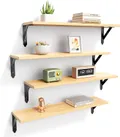 Check price on Amazon
Wood floating shelves, 23.6 inch, Natural
23.6 in long × 6 in deep